


Advanced vaping techniques are specialised methods that experienced vapers use to control vapour density, flavour complexity, and device performance beyond the basics. This guide covers the core practices that separate casual users from true enthusiasts: coil building with fused and mesh builds, precise airflow tuning, temperature control modes, and flavour layering with structured e-liquid profiles. If you already understand ohm’s law, know your way around a rebuildable atomiser, and want to push your setup further, this advanced vaping techniques overview gives you the detail you need to do exactly that.
1. Essential coil building techniques for advanced vaping
Coil building is the foundation of any serious vaping setup, and the type of coil you choose directly determines vapour output and flavour clarity. Fused or mesh coil builds produce up to 30% more vapour density compared to standard wire coils. That gain comes from increased surface area, which heats e-liquid more evenly and generates denser, more consistent clouds.
The three most common coil materials each serve a different purpose:
- Kanthal (FeCrAl): The go-to for wattage mode. It is durable, easy to work with, and holds its shape well after dry firing.
- Stainless steel (SS316L): Works in both wattage and temperature control modes. It ramps up quickly and produces a clean, neutral flavour.
- Nickel-chromium (Ni80): Softer than kanthal but excellent for flavour. Preferred by vapers who prioritise taste over cloud production.
Fused Clapton coils wrap a thinner wire tightly around two or more parallel core wires, creating a textured surface that holds more e-liquid per fire. Mesh coils use a flat, perforated sheet instead of a wound wire, delivering even heat distribution across a wider surface. Both outperform simple round wire builds for flavour and cloud production.
Coil longevity depends on how well you maintain them. Rinse used coils in warm water, allow them to dry fully, and dry fire them gently before re-wicking. Replace coils when you notice a persistent burnt taste, discolouration, or visible gunk buildup on the wire.
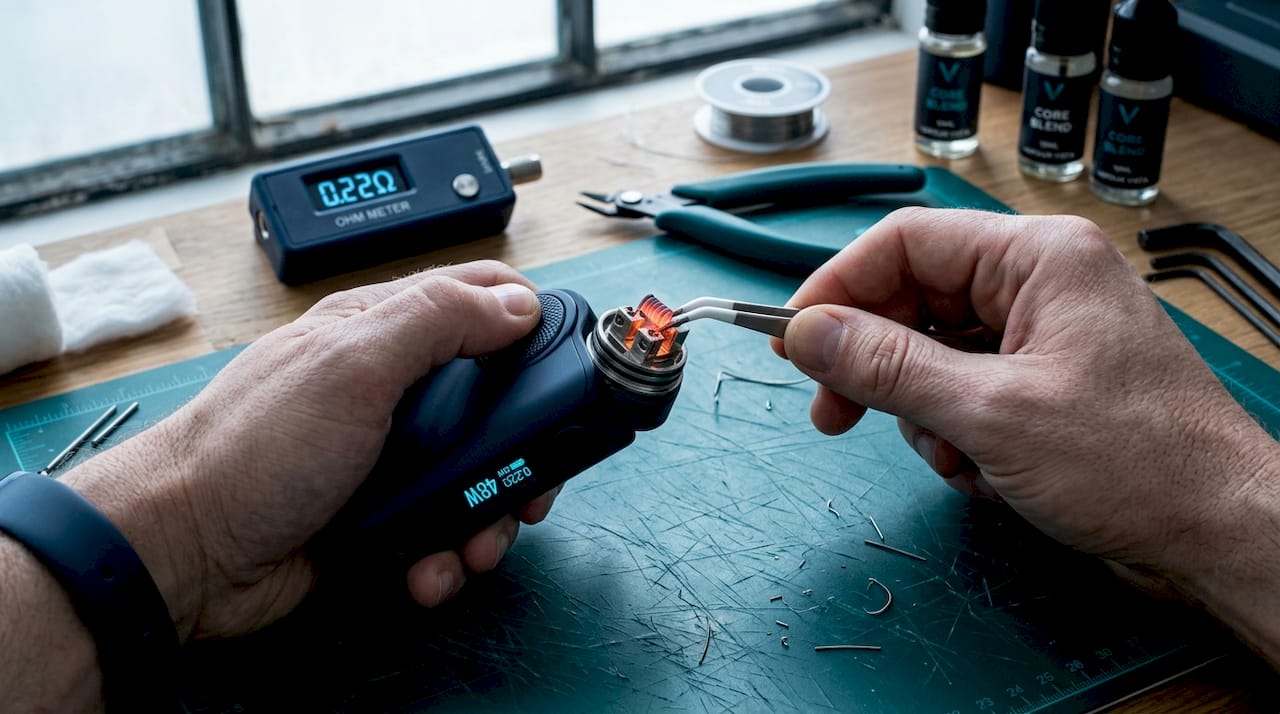
Pro Tip: Pulse fire a new coil at low wattage before installing the wick. This reveals hotspots as uneven glowing along the wire. Correct them by gently squeezing the coil with ceramic tweezers before wicking.
2. How airflow tuning shapes your vaping experience
Airflow is the fundamental variable defining vapour quality. Wide-open airflow produces cooler, larger clouds. Restricted airflow intensifies flavour but risks overheating if the balance is off. Understanding this trade-off is what separates a well-tuned setup from one that underperforms.
For sub-ohm tanks, a moderately open airflow setting works best. You want enough air to keep the coil cool under high wattage, but not so much that the vapour becomes thin and tasteless. Rebuildable dripping atomisers (RDAs) give you finer control, and most experienced builders prefer a slightly tighter draw to concentrate the flavour hitting the palate.
“Airflow is the foundation of quality vaping, defining vapour volume, temperature, and flavour intensity.” — High-Performance Vaping
The most practical airflow tip for flavour chasers: narrowing airflow by ~20% intensifies e-liquid aroma concentration without drastically reducing cloud output. This is a subtle adjustment, not a dramatic restriction, and it works particularly well with dessert and tobacco profiles where base notes need more heat contact time to express fully.
Key airflow principles to apply:
- Wide-open airflow suits cloud chasing at high wattage (above 80W)
- Restricted airflow suits flavour-focused builds at moderate wattage (40W to 70W)
- Rebuildable atomisers respond more precisely to airflow changes than pre-built tanks
- Always adjust airflow before changing wattage to isolate the variable
3. Advanced device modes and temperature control
Modern regulated mods offer a range of output modes, and knowing when to use each one is a core part of expert vaping strategies. The six modes most relevant to advanced vapers are:
| Mode | How it works | Best for |
|---|---|---|
| Temperature control (TC) | Limits coil temperature in real time | Preventing dry hits, coil longevity |
| TCR (temperature coefficient of resistance) | Custom resistance curve for specific wire | Precision tuning with exotic coil materials |
| Variable wattage | Fixed power output regardless of coil temp | Cloud chasing, simple setups |
| Bypass | Outputs raw battery voltage directly | Mechanical mod feel on a regulated device |
| Pulse mode | Alternates power delivery to reduce heat | Smooth, consistent flavour on dense builds |
| Smart/auto mode | Device selects wattage based on coil resistance | Convenient for beginners moving to advanced kits |
Temperature control mods adjust output in real time to maintain a set coil temperature, extending coil life and preserving flavour consistency across a session. This matters because a coil that overheats degrades faster and produces harsher vapour. TC mode eliminates that variable entirely.
Temperature stepping is a technique worth mastering. You start a session at a lower temperature, around 180°C, then gradually increase to 210°C or beyond across multiple puffs. This sequential extraction draws out lighter flavour compounds first, followed by heavier, richer notes as the temperature rises. The result is a more complex, layered flavour profile from the same e-liquid.
Pro Tip: When using TC mode with stainless steel coils, set your temperature limit 10°C to 15°C below the point where you notice flavour degradation. This gives you a safety margin without sacrificing vapour quality.
4. Mastering flavour layering and e-liquid selection
E-liquid flavour profiles rely on a three-tier structure: top notes, heart notes, and base notes. Top notes are the immediate, bright flavours you taste on the inhale, such as citrus or menthol. Heart notes form the body of the flavour, typically fruit or floral elements. Base notes are the rich, lingering tastes on the exhale, like vanilla, caramel, or tobacco.
A well-formulated e-liquid balances all three tiers so that no single note dominates or fades too quickly. This is why some cheaper liquids taste flat after a few puffs. The top notes evaporate too fast, and there is nothing underneath to sustain the experience. Choosing premium e-liquids with a deliberate flavour architecture makes a measurable difference to your vaping satisfaction.
Device choice also affects how you perceive flavour. Pod systems with higher resistance coils (above 1.0 ohm) tend to highlight top notes and suit nic salt liquids. Sub-ohm setups with low-resistance coils amplify base notes and work best with high-VG freebase liquids at 70% VG or above.
Steeping is the process of maturing an e-liquid before use. Steeping over 7 to 30 days in dark, room-temperature conditions with occasional agitation blends the flavour compounds and softens harsh notes. Freshly mixed liquids often taste sharp or chemical. A properly steeped bottle of the same liquid can taste noticeably smoother and more rounded.
E-liquid characteristics best suited to advanced vaping setups:
- High VG ratio (70% or above) for dense vapour and smooth inhale
- Complex dessert or tobacco profiles that reward lower temperatures and restricted airflow
- Freebase nicotine at 3mg to 6mg for sub-ohm use, where vapour volume is high
- Single-flavour concentrates for vapers who want to build custom blends
5. Safety and maintenance practices for advanced vapers
Coil maintenance is not optional at the advanced level. Experienced vapers inspect coils every few days rather than waiting for obvious signs of failure. Gunk buildup, which is caramelised sweetener residue from e-liquid, accumulates on the wire and degrades both flavour and vapour quality. Catching it early means a quick clean rather than a full replacement.
Device lifespan is a safety consideration, not just a performance one. Research from UC Riverside found that prolonged use of high-puff devices significantly raises toxic compounds like methylglyoxal, which is 10 to 100 times more toxic than acetaldehyde. This means puff count is a genuine safety variable, not just a marketing figure. When a device approaches its rated puff limit, replace it rather than pushing it further.
Tracking your usage is straightforward on most modern mods, which display a puff counter in the settings menu. For disposable or pod-based devices, the device toxicity risk increases as the puff count approaches the end-of-life threshold. You can also check the cost comparison between devices to make a more informed decision about when to replace versus repair.
Pro Tip: Set a weekly reminder to inspect your coils and clean your tank. Wipe the inside of the tank with a dry cloth, rinse the coil under warm water, and allow it to air dry for at least two hours before re-use. This routine takes under ten minutes and extends coil life significantly.
Key takeaways
Advanced vaping performance depends on combining precise coil selection, controlled airflow, temperature management, and structured e-liquid choices rather than relying on any single technique.
| Point | Details |
|---|---|
| Coil material matters | Stainless steel suits both TC and wattage modes; Ni80 prioritises flavour over cloud production. |
| Airflow controls flavour intensity | Narrowing airflow by approximately 20% concentrates aroma without major cloud loss. |
| Temperature control extends coil life | TC mode prevents overheating, reduces dry hits, and keeps flavour consistent across sessions. |
| Flavour layering requires structured e-liquids | Top, heart, and base notes must be balanced; steeping for 7 to 30 days improves complexity. |
| Maintenance is a safety practice | Replacing devices near their puff limit reduces exposure to toxic compound accumulation. |
What I have learned from years of advanced vaping
The biggest mistake I see experienced vapers make is treating cloud production and flavour as competing goals. They are not. The vapers who get the most from their setups are the ones who understand that airflow, coil choice, and temperature all interact. Adjust one variable at a time, and you will understand your device far better than someone who changes everything at once and cannot identify what made the difference.
Moving from standard coils to fused Clapton or mesh builds is the single highest-impact change most intermediate vapers can make. The vapour density increase is immediate and noticeable. But the technique only pays off if your airflow and wattage settings are calibrated to match. A mesh coil running at the wrong wattage in a fully open airflow setup will produce thin, flavourless vapour despite the hardware advantage.
Flavour layering is where advanced vaping becomes genuinely interesting. Once you start thinking about e-liquids the way a chef thinks about ingredients, you stop settling for one-dimensional profiles. Steeping a complex dessert liquid for three weeks and then running it through a well-tuned sub-ohm setup at 55W with slightly restricted airflow is a completely different experience from vaping it straight out of the bottle at default settings.
My honest advice: keep a simple log of your settings, coil type, and e-liquid for each session. It takes thirty seconds and gives you a reference point when something works exceptionally well or goes wrong. Most advanced vapers who plateau do so because they cannot reproduce their best results. A basic log solves that entirely.
— Daniel P
Get the right kit from Vapourvista

If you are ready to put these techniques into practice, Vapourvista stocks the advanced mods, rebuildable atomisers, and high-VG e-liquids you need to build a serious setup. The range includes devices suited to temperature control, variable wattage, and pulse modes, alongside a curated selection of premium e-liquids chosen for their flavour complexity and VG balance. Vapourvista offers fast UK delivery on all orders, so you are not waiting days to try a new coil build or e-liquid profile. Browse the full range and take advantage of the loyalty programme that rewards every purchase with points towards your next order. Order with fast UK delivery and get your advanced setup sorted today.
FAQ
What is the best coil type for advanced vaping?
Fused Clapton and mesh coils are the top choices for advanced vapers. Mesh coils offer even heat distribution and up to 30% more vapour density compared to standard wire builds.
How does temperature control mode benefit experienced vapers?
Temperature control mode adjusts output in real time to prevent overheating, which extends coil life, eliminates dry hits, and keeps flavour consistent throughout a session.
What does steeping an e-liquid actually do?
Steeping blends flavour compounds over 7 to 30 days in dark, room-temperature conditions, softening harsh notes and producing a smoother, more rounded taste profile.
How much should I restrict airflow to improve flavour?
Narrowing airflow by approximately 20% from your usual setting concentrates aroma intensity without a significant reduction in cloud output. This works best with dessert and tobacco profiles.
When should I replace a high-puff vaping device?
Replace a device when it approaches its rated puff limit. Research shows that toxic compound levels, including methylglyoxal, increase significantly as devices reach end-of-life puff counts.